|
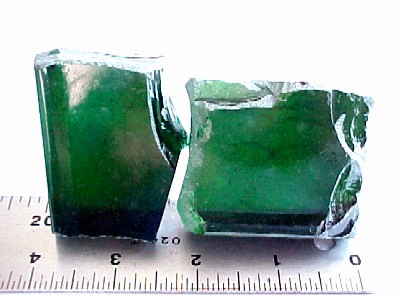
a. Attempts in late 1800's with commercial development successful in
late 1930's and early 1940's.
b. Method
1) Powdered ingredients mixed with flux in
platinum crucible.
2) May have seed crystal.
3) Flux has a lower melting point and becomes a
powerful solvent for the other ingredients, causing them to melt.
4) Cooling and evaporation causes
crystallization of individual crystal in clusters.
5) Most natural appearance of the synthetics.
6) Takes up to one year.
c. Characteristic Inclusions
1) Flux inclusions in wispy veils, globules,
drippy icicles.
2) Platelets - platinum flakes.
3) Fingerprints - healed fractures.
4) Straight growth zoning--indicates gemstone
cut from a well-developed single crystal (also occurs in natural
gemstones).
5) Included seed crystals.
d. Materials Synthesized (expensive)
1) Synthetic corundum.
2) Synthetic emerald.
3) Synthetic alexandrite.
4) YAG |
a. 1800대 후반에 시도되어 1930년대 후반과 1940년대 초반에 상업적으로
개발성공
b. 방법
1) 용제와 섞인 분말재료들을 백금 도가니에 넣음
2) 결정 종자를 넣을 수도 있음
3) 용제는 용융점이 낮아 다른 재료들이 잘 녹게
해주는 용매의 역할을 함
4) 냉각하고 증발시키면 개별결정이 집단으로
결정화됨
5) 가장 자연스런 모습을 지닌 합성들
6) 일년이 걸림
c. 특유의 내포물들
1) 가느다란 가림막들, 작은 구체들, 떨어지는
고드름들과 같은 용제 내포물들
2) 작은 판들 - 백금 조각들
3) 지문들 - 치료용 깃털을 닮은 파면들
4) 직선의 성장 구역 - 잘 발달된 한 개의
결정에서 잘라낸 원석을 나타낸다 (자연 원석들에서도 생김)
5) 결정종자들을 함유함
d. 합성되는 물질들 (비쌈)
1) 합성 강옥
2) 합성 취옥
3) 합성 알렉잰드라이트
4) 야그 |
 |
GGG (gadolinium-gallium garnet),
EGG (europium-gallium garnet), SGG (samarium-gallium garnet),
YIG (yttrium-iron garnet)
1 .
GGG colorless;
2. GGG red - pomegranate (Mn);
3. EGG lilac - ametyst (Nd);
4. EGG green - chrysolite (cr)
5. GGG green - emerald (?);
6. GGG bluish-green - green zircon (?);
7. GGG blue - indigo (Co,Ti);
8. GGG red + green, watermelon tourmaline alike, (?);
9. GGG red + blue, watermelon tourmaline alike, (?);
10. EGG greenish - yellow - peridot (Co);
11. SGG yellow - yellow topaz (no additional metals);
12. SGG yellow - amber,brandy (Fe);
13.YIG black (no additional metals)
|